


A lot of companies put serious money into their trade show presence, especially in the B2B tech space. The booth is designed well, the screens look sharp, the messaging is approved, and the team shows up ready to talk about the product. On paper, everything seems to be in place.
But once the show opens, the booth still depends on one fragile thing: whether attendees decide to stop.
That is where many companies lose momentum. They build a booth that looks professional, but they do not always build an experience that gives people a reason to engage. In B2B tech trade show marketing, looking credible matters, but credibility alone does not create conversations. A booth has to do more than exist. It has to create a moment that pulls people in and helps them understand why they should care.
Experiential Trade Show Marketing Is Not Just About the Booth Design
When people hear experiential trade show marketing, they often think about the physical environment. They picture the booth structure, the lighting, the graphics, the demo stations, and maybe a giveaway or interactive screen. Those things can help, but they are not the experience by themselves.
The real experience is what happens between your team and the attendee.
This is especially important in experiential marketing for tech companies, because many tech products are not instantly obvious. A SaaS platform, cybersecurity solution, data tool, or AI product often needs context before it becomes interesting. If an attendee does not quickly understand the problem you solve or why it matters to them, they may keep moving, even if your solution is genuinely valuable.
That is why interaction has to be designed as intentionally as the booth itself. What happens in the first few seconds? Who starts the conversation? How is curiosity created? How does the attendee move from casual interest to a meaningful discussion? These are the questions that separate a passive booth from an active one.
The Trade Show Presenter Creates a Focal Point
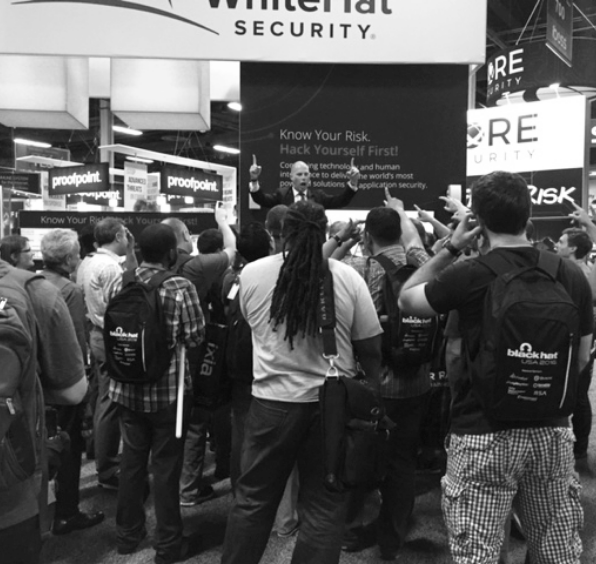
A strong trade show presenter can change the energy of a booth because they create a clear focal point. Instead of waiting for people to wander in and ask questions, the presenter gives attendees a reason to stop, watch, listen, and participate.
This matters because trade shows are crowded environments. Attendees are being pulled in every direction. They are scanning signs, checking their phones, looking for meetings, and trying to decide which booths are worth their time. A presenter helps cut through that noise by making the booth feel alive.
Good trade show presentations are not just mini product pitches. They are structured experiences. They capture attention, create curiosity, make the message easier to understand, and guide people toward the next step. For companies focused on SaaS trade show engagement, this can be the difference between scattered one-on-one explanations and a repeatable message delivered to many qualified attendees throughout the day.
SaaS Trade Show Engagement Needs Structure
One of the biggest challenges with SaaS trade show engagement is that the product often cannot be fully understood in a few seconds. The value may depend on workflow, integration, efficiency, security, automation, visibility, or cost savings. Those are important, but they are not always obvious from a booth graphic.
That is why structure matters.
If every conversation starts differently, the booth team has to recreate the message over and over again. Some reps may explain it clearly. Others may go too deep too quickly. Some attendees may get a great experience, while others only hear a vague version of the value proposition.
Structured trade show presentations solve that problem. They make the message consistent without making it feel robotic. They give the team a shared language. They also create natural openings for follow-up conversations, demos, scans, and meetings. In a busy booth, that consistency is valuable because it helps turn attention into actual sales opportunities.
Trade Show Training Turns the Team Into Part of the Experience
The booth staff should not be treated as an afterthought. They are often the difference between a booth that feels active and one that feels awkward.
Many companies invest heavily in the exhibit but give very little attention to trade show training. The team may know the product, but that does not mean they know how to engage people in a live trade show environment. Product knowledge is useful once the conversation is happening. The harder part is earning the conversation in the first place.
Trade show training helps the team understand how to approach attendees, ask better opening questions, read body language, avoid passive booth behavior, and move people toward a clear next step. It also helps prevent one of the most common booth mistakes: relying on the attendee to do all the work.
If the default line is “Let me know if you have any questions,” the booth is already operating from a passive position. Training gives the team a better way to engage without sounding pushy or forced.
Better Trade Show Exhibit Ideas Start With Interaction
A lot of trade show exhibit ideas focus on what can be added to the booth: coffee, games, giveaways, prize wheels, screens, lounges, demos, or entertainment. Some of those ideas can work, but only when they are connected to a larger engagement strategy.
The question is not just “Will this attract people?” The better question is “What happens after it attracts people?”
That is where many booth ideas fall apart. A giveaway can create traffic, but it may not create qualified conversations. A game can create activity, but it may not create understanding. A demo station can be useful, but only if people are guided toward it with a clear reason to care.
This is why a trade show magician or infotainer can be effective when used properly. The point is not to add random entertainment to the booth. The point is to create attention, lower resistance, gather people, and transition that attention into the company’s message. When the performance is connected to the business story, it becomes part of the engagement strategy instead of a distraction from it.
Experiential Marketing for Tech Companies Should Lead to Pipeline
The goal of experiential marketing for tech companies is not just to make the booth more exciting. The real goal is to create better business outcomes.
That means the experience has to support pipeline. It should help the right people stop, understand the value, identify themselves as interested, and move toward a next step. If the booth is busy but the conversations are weak, the experience is not doing enough. If people enjoy the activation but do not understand the message, the experience is incomplete.
Strong B2B tech trade show marketing connects the experience to the outcome. It does not treat engagement as decoration. It uses engagement to make the message easier to receive, easier to remember, and easier to act on.
Final Thought
A trade show booth is not successful just because it looks impressive. It is successful when it creates the right kind of interaction with the right kind of attendee.
That requires more than booth design. It requires a strong trade show presenter, intentional trade show presentations, practical trade show training, and trade show exhibit ideas that are built around engagement instead of distraction.
For SaaS and tech companies, the opportunity is not just to be seen at the show. The opportunity is to be understood, remembered, and acted on.
That is where experiential trade show marketing earns its value.
Ready to turn your next trade show booth into a real engagement opportunity? Book an Insight Session now.