The process behind on-demand lead generation on the trade show floor.
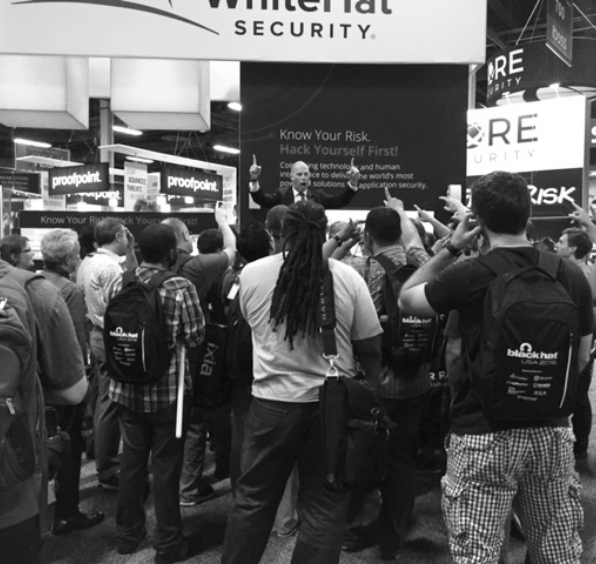
Every VP of Marketing wants to walk onto the trade show floor and see their booth packed with people.
There’s something powerful about those optics. A busy booth creates a magnetic presence, signals market relevance and gives the impression that your company is a mover and shaker in its industry.
But what if you didn’t have to leave that to chance?
What if you could manufacture a crowd, communicate your company’s value proposition, qualify prospects and move them deeper into your booth whenever you wanted?
At Engagify, that’s what we call on-demand lead generation.
Here’s how it works.
1. Create an Event Within the Event
Every crowd starts with a few people.
The first step is to give attendees a compelling reason to interrupt their journey down the aisle.
It could be a unique experience, an interactive presentation or the opportunity to receive a desirable giveaway. Whatever the attraction mechanism, you’re essentially creating an event within the event.
But getting people to stop isn’t enough. You need to give them a reason to stay.
If someone walks up, collects a giveaway and immediately leaves, you’ve generated traffic, but you haven’t built a crowd.
By increasing dwell time through interaction, anticipation and participation, you create the conditions for more people to assemble.
Three’s company. Four’s a crowd.
2. Reach Critical Mass
Nothing draws a crowd like a crowd.
Once enough people gather, the crowd itself becomes an attractor. Social proof, curiosity and the fear of missing out (FOMO) start working in your favour.
Attendees see other people investing their time and attention in something and assume there must be some value in it.
They want to know what they’re missing.
The bigger the crowd gets, the bigger the crowd gets.
This is where your booth begins to develop its own gravitational pull. Rather than relying exclusively on your booth design, branding or staff to attract attention, the people you’ve already engaged are helping attract others.
3. Leverage Collective Attention
Now that you have a crowd, what are you going to do with it?
One of the greatest advantages of crowd building is the leverage it gives you through one-to-many communication.
Instead of having 30 separate conversations to communicate what makes your company different, you can deliver that message once to 30 people.
However, communicating to a crowd requires a different approach than communicating one-on-one.
You can’t afford to go down a technical rabbit hole that’s relevant to only 10% of your audience and risk losing the other 90%.
Your message needs to be accessible enough for everyone to understand, while being compelling enough for the right people to want to learn more.
Focus on the problems you solve, your points of differentiation and the value you create.
The objective isn’t to tell them everything. It’s to make them want to know more.
4. Find Quality in the Quantity
One of the objections I sometimes hear about crowd building is that not everyone in the crowd is going to be a qualified prospect.
Of course not.
But there is quality in the quantity.
The more people you engage, the more opportunities you have to identify those who fit your ideal customer profile (ICP).
At Engagify, we use a technique called hand-raise qualification.
Through strategically crafted questions, attendees essentially self-identify based on their challenges, responsibilities or current circumstances.
This allows us to qualify prospects at scale while helping those prospects recognize the relevance of the solution being presented.
From there, we can call them to action:
If you’ve raised your hand and identified this as a challenge you’re experiencing, wouldn’t it make sense to take a closer look?
After all, that’s why your company sent you to the trade show in the first place: to solve problems, discover solutions and create value.
5. Move the Right People Deeper
This is where the process really starts paying dividends.
Having whetted the appetite of qualified prospects, we can now transition them to the subject matter experts within the booth.
In this more intimate environment, attendees can experience a product demonstration, ask specific questions and explore how the solution applies to their organization.
Your subject matter experts can now do what they do best.
Instead of spending their time trying to attract passersby or repeatedly explaining the company’s basic value proposition, they’re having more meaningful conversations with prospects who already have some understanding of the solution and a reason to be interested.
We’ve effectively moved them further down the marketing funnel in a matter of minutes.
6. Rinse and Repeat
Perhaps the most valuable aspect of this process is its repeatability.
When one group of qualified prospects moves deeper into the booth, the crowd-building process can begin again.
Throughout the trade show day, you’re creating waves of engagement that feed your demo stations and subject matter experts with new prospects.
You’re not simply waiting for the right people to walk into your booth. You’re proactively creating opportunities to find them.
That’s the difference between relying on trade show traffic and engineering trade show engagement.
From Passersby to Pipeline
A busy booth is great for optics, but the business value comes from what you do with that attention.
Attract. Connect. Convey.
When you execute these three stages of engagement at scale, you create a repeatable process for moving attendees from initial curiosity to meaningful sales opportunities.
And that’s what makes on-demand lead generation such a powerful addition to your exhibiting strategy.
Don’t just invest in a booth that looks good.
Invest in making that booth perform.
Want to engineer more engagement, qualified leads and sales opportunities at your next trade show? Book an Insight Session with Engagify.